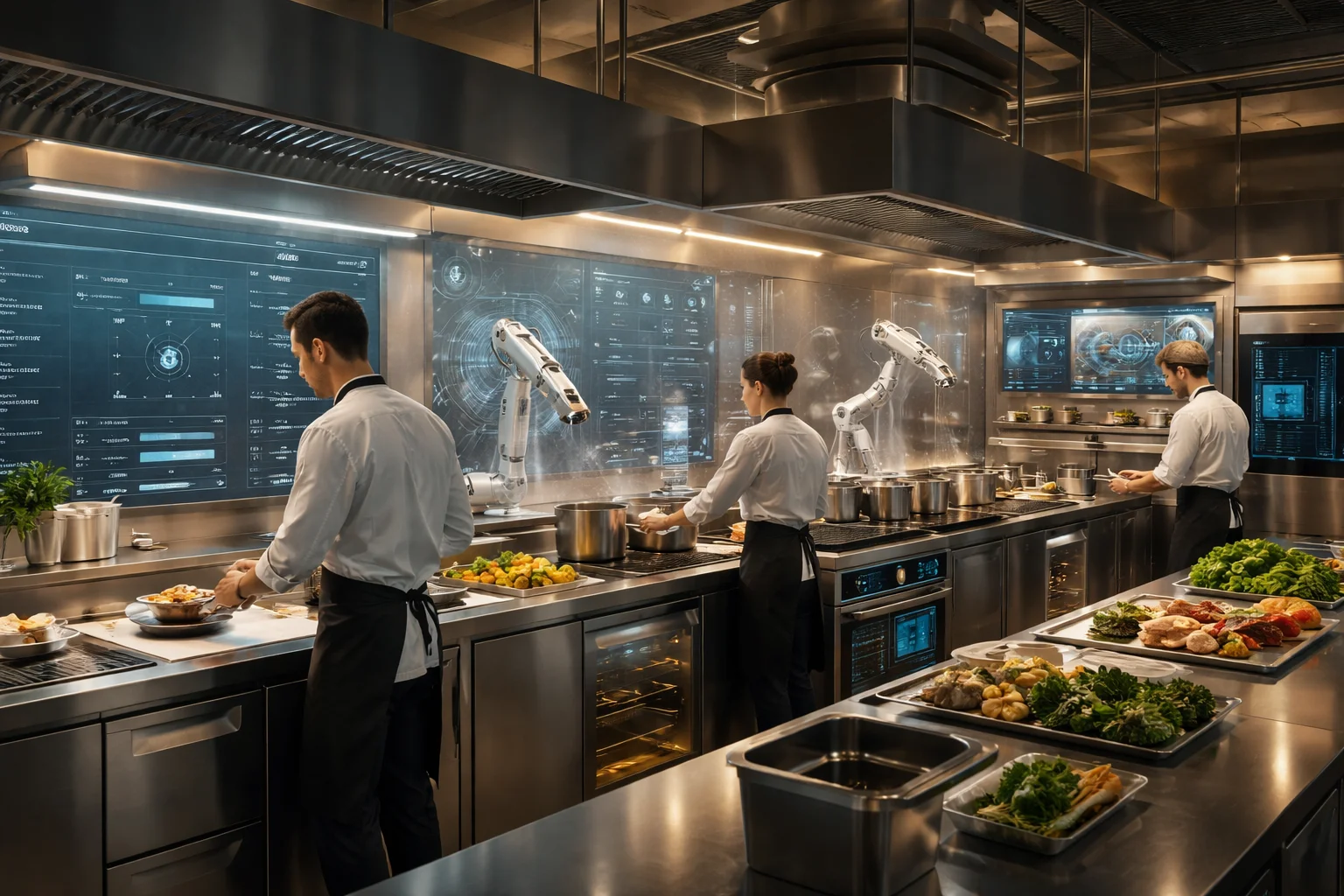
Qu, a long-standing innovator in restaurant technology, has unveiled a major evolution in its product strategy with the introduction of its Intelligent Commerce Platform (ICP). This new platform represents a significant shift in how artificial intelligence is applied within restaurant operations, moving beyond traditional, disconnected AI tools toward a fully integrated, edge-powered intelligence system embedded directly into the operational fabric of restaurants.
The company plans to officially showcase this platform at the Restaurant Leadership Conference 2026, scheduled from April 19–22 in Phoenix. The timing of this launch is notable, as the restaurant industry is currently navigating one of its most challenging economic environments in recent years.
Across the sector, operators are facing mounting pressure from rising labor and food costs, declining customer traffic in certain segments, and profit margins that are hovering near historic lows. At the same time, artificial intelligence has become a focal point of investment and innovation. However, despite the growing enthusiasm around AI, many restaurant operators are struggling to translate that investment into meaningful business outcomes.
According to Qu’s 2026 Restaurant Technology Benchmark Report, while 73% of restaurant operators are actively investing in AI technologies, only 5% report achieving measurable value from those investments. Additionally, 55% of respondents identified operational execution—not technology adoption—as their most significant challenge. This gap between investment and impact highlights a critical flaw in how AI solutions are currently deployed across the industry.
Qu’s Intelligent Commerce Platform is designed specifically to address this disconnect. Rather than layering AI capabilities on top of fragmented, legacy systems—a common approach among many technology providers—ICP embeds intelligence directly within a unified commerce infrastructure. This means AI is not treated as an add-on, but as a core operational component that functions seamlessly across every touchpoint, from order processing to kitchen management and enterprise decision-making.
A defining feature of ICP is its emphasis on edge computing. Instead of relying heavily on cloud-based AI models—which can become costly and introduce latency—the platform enables AI to run directly at the store level and across local systems. This approach not only improves real-time responsiveness but also helps control costs, making AI deployment more sustainable for restaurant operators.
As Amir Hudda, CEO of Qu, explained, the industry does not necessarily need more AI—it needs AI that aligns with the operational and financial realities of running a restaurant. Cloud-based AI models, while powerful, can lead to unpredictable cost scaling. By contrast, Qu’s edge-first strategy ensures that intelligence is deployed where it is most efficient and cost-effective, allowing operators to improve both top-line revenue and bottom-line profitability.
The Intelligent Commerce Platform introduces a wide range of capabilities aimed at enhancing operational efficiency and customer experience. Among the most notable features is the real-time Kitchen Intelligence Score, which provides actionable insights into kitchen performance. These insights are delivered through Qu’s Notify mobile application, enabling managers and staff to respond quickly to issues as they arise.
In addition, the platform incorporates production forecasting and dynamic demand planning tools. These capabilities help restaurants better anticipate customer demand, optimize kitchen workflows, and maintain consistent service speeds even during peak periods. By balancing kitchen loads in real time, operators can significantly improve throughput and reduce bottlenecks.
AI-powered ordering and computer vision are also central components of the platform. These technologies work together to enhance order accuracy, monitor kitchen activity, and identify inefficiencies. For example, computer vision can detect delays or congestion in food preparation areas, allowing staff to take corrective action before problems escalate.
Another important area of focus is energy and equipment intelligence. ICP continuously monitors the health and performance of kitchen equipment, helping operators reduce energy consumption and prevent costly breakdowns. Early detection of potential issues not only minimizes downtime but also extends the lifespan of critical assets.
At the enterprise level, the platform introduces AI agents designed to optimize decision-making around promotions, discounts, and pricing strategies. These agents analyze data across multiple locations to recommend actions that maximize profitability while maintaining a strong customer value proposition.
Early adopters of Qu’s intelligent commerce capabilities are already reporting significant improvements across key performance metrics. These include a 25% reduction in guest wait times and a 29% increase in drive-thru speed—both of which directly impact customer satisfaction. Operational efficiencies are also evident, with a 2.5–3% decrease in food and labor costs and a 30–50% reduction in issue resolution times.
Administrative tasks have become substantially more efficient as well. Operators report spending 20–40% less time reviewing reports and up to 85–90% less time managing menus. These gains free up valuable time for staff to focus on higher-value activities, such as improving service quality and enhancing the guest experience.
Industry leaders are taking note of this approach. Dawn Gillis, CTO at Golden Corral, emphasized the importance of aligning AI with the economic realities of the restaurant business. With margins already under pressure, solutions that introduce hidden or escalating costs are simply not viable. She highlighted Qu’s use of edge AI as a more practical and affordable path toward modernization, enabling operators to adopt advanced technologies without compromising profitability.
Importantly, the Intelligent Commerce Platform is not a standalone product but an evolution of Qu’s existing unified commerce foundation. Current customers can access these new capabilities as part of the platform’s ongoing development, ensuring continuity while unlocking new levels of performance and insight.
At the upcoming Restaurant Leadership Conference, attendees will have the opportunity to see the platform in action at booth 337. Qu will also collaborate with partners such as Bites and ConverseNow to demonstrate integrated AI and voice ordering solutions. These integrations ensure that every order flows directly into the point-of-sale system, preserving critical data while maintaining control over margins and customer relationships.
In many ways, Qu’s Intelligent Commerce Platform represents a broader shift in how technology is being designed for the restaurant industry. Rather than prioritizing innovation for its own sake, the focus is increasingly on delivering practical, measurable outcomes that address real-world challenges. By embedding intelligence directly into operations and leveraging edge computing to control costs, Qu is positioning itself at the forefront of this transformation.
As the industry continues to evolve, solutions like ICP may play a crucial role in helping restaurant operators navigate uncertainty, improve efficiency, and build more resilient, data-driven businesses.
Qu is the unified commerce platform helping quick-service and fast-casual restaurants boost efficiency and grow revenue. Purpose-built from the ground up with smart cloud technology, Qu puts real-time intelligence where it’s needed most – right in the restaurant – through its proprietary Business Edge, Qube. The result: streamlined operations, stronger margins, and memorable guest experiences.
On a mission to propel restaurants beyond today’s limitations, Qu is a long-term technology partner trusted to deliver solutions that are as reliable as they are revolutionary, and intuitive as they are impactful.
Based in Arlington, Virginia, Qu is backed by leading restaurant entrepreneurs and investors, including Cota Capital, Enlightened Hospitality Investments, Bobby Cox Companies, and NRD Capital.