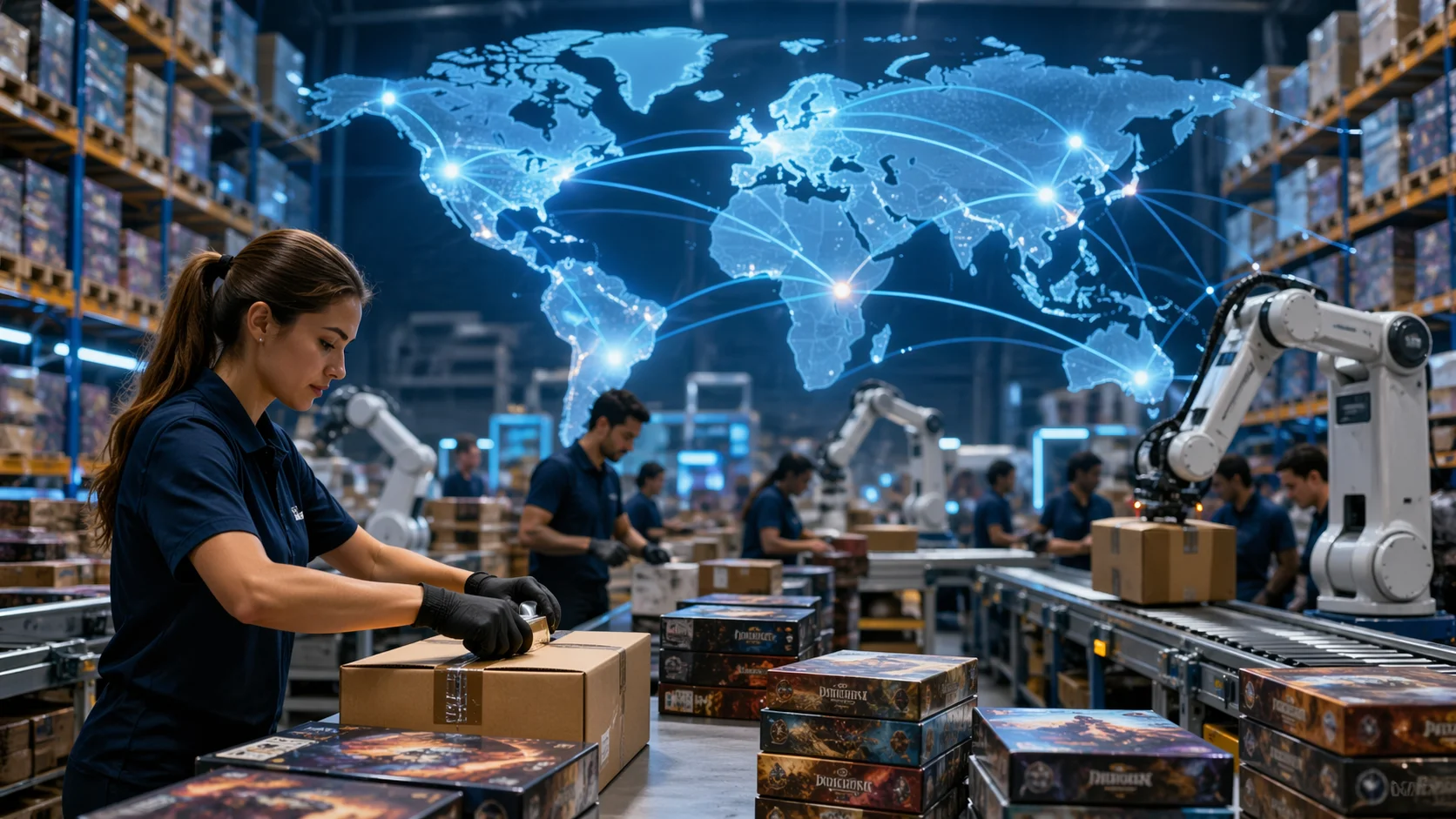
NextSmartShip (NSS), a leading global e-commerce fulfillment provider, has released a comprehensive new case study titled “How NextSmartShip Streamlined Global Logistics for Tin Robot Games.” The report offers an in-depth look at how Tin Robot Games, an independent board game publisher, successfully transformed its logistics strategy to overcome operational inefficiencies and scale its business internationally. At the center of the story is founder James Staley, a solo entrepreneur who leveraged NSS’s China-based fulfillment model to reduce costs, improve efficiency, and regain valuable time to focus on business growth.
As crowdfunding platforms such as Kickstarter and Gamefound continue to democratize product launches, independent creators and small businesses now have unprecedented access to global markets. However, while these platforms lower the barrier to entry, they also introduce a new set of challenges once a product achieves international demand. Chief among these is logistics.
For many small businesses, scaling globally often results in what industry experts call a “logistics logjam.” This occurs when fragmented distribution systems, high shipping costs, and complex cross-border regulations begin to overwhelm limited operational resources. Without the infrastructure of larger corporations, micro-publishers like Tin Robot Games often find themselves struggling to balance growth with efficiency.
Before partnering with NextSmartShip, Tin Robot Games faced exactly this dilemma. Despite producing successful board game campaigns, the company’s logistics network was inefficient, costly, and time-consuming.
One of the most pressing issues for Staley was the sheer amount of time required to manage logistics. Coordinating shipments across multiple regions, dealing with different distributors, and resolving customer issues consumed nearly 25% of his working hours. For a solo entrepreneur, this represented a significant diversion of time away from product development, marketing, and customer engagement.
In addition to time constraints, inventory management posed another major challenge. Stock was distributed across multiple warehouses in different countries, making it difficult to track inventory levels accurately. This fragmentation also limited the company’s ability to bundle orders or efficiently fulfill add-ons for crowdfunding backers, resulting in missed revenue opportunities and customer dissatisfaction.
Compounding these issues were high brokerage and shipping fees. Traditional fulfillment methods, particularly those relying on ocean freight and regional distributors, added layers of cost that eroded profit margins. Furthermore, as a small business, Tin Robot Games often struggled to receive adequate support from logistics providers, who typically prioritize larger clients.
The turning point came when Tin Robot Games partnered with NextSmartShip and adopted a centralized “China-to-consumer” fulfillment strategy. By leveraging NSS’s Shanghai-based hub, the company was able to ship products directly from the manufacturing source to customers worldwide.
This approach eliminated the need for multiple intermediaries and significantly streamlined the distribution process. Instead of sending bulk shipments to various international warehouses, products were dispatched directly to end customers, reducing both transit times and handling costs.
The results were immediate and impactful.
One of the most notable improvements was the reduction in transit time. By bypassing traditional container shipping methods, Tin Robot Games cut delivery times by approximately six weeks. This not only enhanced customer satisfaction but also allowed the company to respond more quickly to demand fluctuations.
Equally transformative was the introduction of NextSmartShip’s self-service dashboard. This platform gave Staley real-time visibility into global operations, enabling him to manage orders, track shipments, and resolve issues in a matter of minutes. The system also included automated alerts that flagged potential shipping errors, helping to prevent costly mistakes before they occurred.
What once required hours of manual coordination could now be handled efficiently through a centralized interface.
Perhaps the most significant outcome of the partnership was the reduction in landed costs. By consolidating fulfillment operations and eliminating unnecessary intermediaries, Tin Robot Games achieved a 10% decrease in overall shipping expenses. For a small business operating on tight margins, this level of savings can make a substantial difference in profitability.
In addition to financial benefits, the new logistics model allowed Staley to reclaim nearly half of the operational bandwidth previously consumed by logistics management. This newfound efficiency enabled him to focus on core business activities, such as designing new games, engaging with the community, and planning future campaigns.
As Staley noted, the shift fundamentally changed the economics of his business. Shipping costs, once a major constraint, became a manageable component of the overall strategy.
Another key advantage of working with NextSmartShip was access to scalable, high-touch support. Unlike many fulfillment providers that impose minimum order requirements, NSS offers a “no minimum order quantity” policy. This makes it particularly well-suited for small and medium-sized businesses that may not have consistent or high-volume shipping needs.
Additionally, Tin Robot Games benefited from dedicated account management, ensuring personalized support and guidance throughout the transition process. This level of service is often reserved for larger enterprises, making it a significant value-add for smaller clients.
The case study highlights a broader trend in the e-commerce and crowdfunding landscape: the need for flexible, scalable logistics solutions tailored to the unique challenges of small businesses. As more creators enter the market, the ability to efficiently manage global distribution will become increasingly critical to long-term success.
Tin Robot Games’ experience demonstrates that with the right partner and strategy, even a solo entrepreneur can compete on a global scale. By adopting a centralized fulfillment model and leveraging advanced technology, small businesses can overcome logistical barriers and unlock new growth opportunities.
NextSmartShip is a strategic fulfillment partner for growing direct-to-consumer brands, providing end-to-end logistics solutions for over 2,000 DTC brands globally. Headquartered in Shenzhen, China and Los Angeles, California, NextSmartShip has 30 fulfillment centers across 13 countries and a robust network of 400+ shipping routes. NextSmartShip simplifies warehousing, order fulfillment, and last-mile delivery for the modern e-commerce era.